Thursday, 8 September 2011

The 12th week in BEL 120 :)

MONDAY :

Drawing a conclusion.

  • Critical thinking. It is relating with something.
  • We need to identified the main point of the text or passage.
*This is one of the videos that we had done in my class for this topic:


TUESDAY:

Do the writing test.
  • Each group must has 4 or 5 members.
  • The first writer, will be makes an essay in paragraph 1.
  • The second writer, will be makes an essay in paragraph 2.
  • It will be continue until writer number five.
  • Writer number five, will write the conclusion of the essay.
  • The writer has been given 12 minutes to write the essay.
  • The question is
" Write an essay of about 230-250 words (consisting of 5 paragraphs) on how the internet can be beneficial for language learning. You may mention benefits such as the internet being a great source of reading material, language learning exercises and offering opportunities to improve communication skills."


The end ((:

The 11th week in BEL120 (:


TUESDAY:


Past Perfect Tense

Past perfect tense verbs are formed with the helping verb had and the verb's past participle.
They show an action that came before another action in the past.
Here are some examples:
The team had won before I arrived.My sister had just left when we walked in the door.

Although this verb tense shows an action that came before another action in the past, that other action does not have to be stated in the sentence.
It can simply be implied.
For instance, these sentences are still made with the past perfect verb tense although the past action is not state like it is in the sentences above.

The team had won.My sister had just left.

What Is a Perfect Tense?

Every verb has three perfect tenses.
The three perfect tenses are formed with the helping verbs have, has, had, will and shall and the past participle of the verb.
1. Present Perfect Verbs are formed with the helping verbs has and have.
2. Past Perfect Verbs are formed with the helping verb had.
3. Future Perfect Verbs are formed with the helping verbs will have andshall have.

Past Participles

You need to know what a past participle is because past perfect verbs are formed using a verb's past participle.
Ready to learn about past participles? Great!
Every verb has what are called four principal parts.
We can take any verb and break it into these parts. Past participles are simply one of those parts of a verb.
Here is a chart showing you some examples of verbs broken into their principal parts.
PresentPresent ParticiplePastPast Participle
kick(is) kickingkicked(have) kicked
won(is) winningwon(have) won
win(is) winningwong(have) won
If you'd like to learn more about past participles, click here

Forming the Past Perfect Tense

So, to form the past perfect verb tense, just slap a had in front of the past participle of the verb.
It's easy!
had+ Past ParticiplearrowPast Perfect
had+ learnedarrowhad learned
had+ wonarrowhad won
had+ graduatedarrowhad graduated


You can refer more to:
http://www.english-grammar-revolution.com/past-perfect-tense.html


WEDNESDAY:

Notes for writing:
  • In essay, don't repeat the thesis statements as a conclusion.
  • The conclusion:making the end paragraph count:
  1. How and why is this topic important?
  2. How might this topic affect me or another people? 
  3. What can be learned from this topic?
  4. Quotation
  5. Provocation/provoking question

Reading comprehension: Making inferences

*What are inferences?
  • Inferences are often referred to as what you "read between the lines".
  • Inferences are what the author implies or suggests.
  • The author wants you, the reader to make the jump to same conclusion the author has made.

@ This one of the videos from my activity in class for this topic:

 
you can refer more to:

Saturday, 3 September 2011

The 10th in BEL120 ((;

Monday;


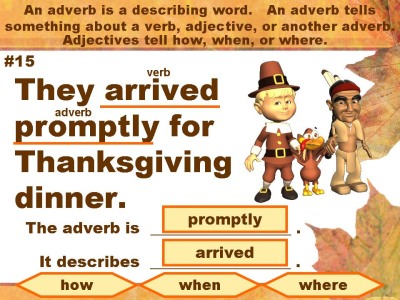
1.Adverbs are also used to describes adjectives

  • ex: That ice-cream is extremely delicious.
2.The other use of adverbs is to describe another adverbs.
  • ex: The guard checks our student cards meticulously
3.The family of adverbs:
  • adverbs of manners
  • adverbs of place
  • adverbs of time
  • adverbs of degree
  • adverbs of frequently

you can refer more to:


Conjunction
* connect the words, phrases, clauses or sentences.
There are three types of conjunction:
i.    coordinating conjunction
   - connect words of the same kind,such as nouns, pronouns, verbs, prepositional phrases or sentences.
ii.   correlative conjunctions
   - similar to coordinating conjunctions in that they connect the same type of words, but work in pairs.
iii.  subordinating conjunction
    - simple prepositions
    - compound prepositions

you can refer more to:
http://www.englishclub.com/grammar/conjunctions.htm


Tuesday:


1. Simple past tense is an actions, events, states that started and finished in the past.
    i)   What did you yesterday?
   ii)   What did you do Friday night?
  iii)   Where were you Saturday morning?
2. Past continues  : three uses

  • use 1 : Past actions that were in progress at a particular time in the past (actions that were not yet finished at a past time)
  • use 2 : two (or more) actions  that were in progress in the past at the same time.
  • use 3 : describe and set the scene; tell what was happening or interruped a past in progress action  
3. Form of past continues
                       subject + was/were + verb-ing
negation       :  subject + was/were + not + verb-ing
yes/no ques. : was/were +subject + verb-ing
info.ques      : WH + was/were + subject + verb-ing


you can refer more to:
http://www.slideshare.net/rosarioa.slide/the-simple-past-tense


Wednesday:
1. Expression that can be use in present tense are.

  •  routine vs moment of speaking
          *ex: James works for an investment magazine. Every months he writ article about new investment.
  • general activity vs current projects.
          *ex: I work for Teletraining: We make training video.<at moment = current>
  • permenent vs temporary situations  
          *ex: Peter deals with enquiries about our carfleet sales.
  • facts vs slow changes
          *ex: As a rule, cheap import lead to greater competition
  • state verbs
           *ex: There are number of verbs which describe states rather that action. They are not normally used in the continues.


The 9th week in BEL120 ((:


Monday:
today, our task is make a forum from the question given.


Question:
Youth today are generally not very patriotic to the country. There are excellent panel which is can give the reasons for the solution and suggest ways to increase youth's awareness of patriotism and instill the love for one's country as well as how they can show their patriotism  to their country.

buddies,for your information,this activity as a warm up for the speaking test.

p/s:the next day in my class, we practice for the test and in wednesday, we were proceeding our speaking test


This are some tentative that we should follow for this test:

Instruction to candidates:
Task A: Individual presentation

  • study the topic
  • you are given one minute to read the question
  • you are given three minutes to prepare your point
  • you are given two minutes to present
  • listen to others while their making their presentations and take down notes for discussion group in tasks B.
Task B: Group presentation
  • after you have listen to everyone, try to come a decision for the discussion.


The 8th week in BEL120 (:

This week, we had prepared our listening test. So, as the conclusion in this week we just practice for the test.
There are some tips that can be followed:
1) listen carefully
2) read the text carefully
3)find the key words


p/s:sorry for the short update for this week.